


The Limitations of Traditional Screening Technologies
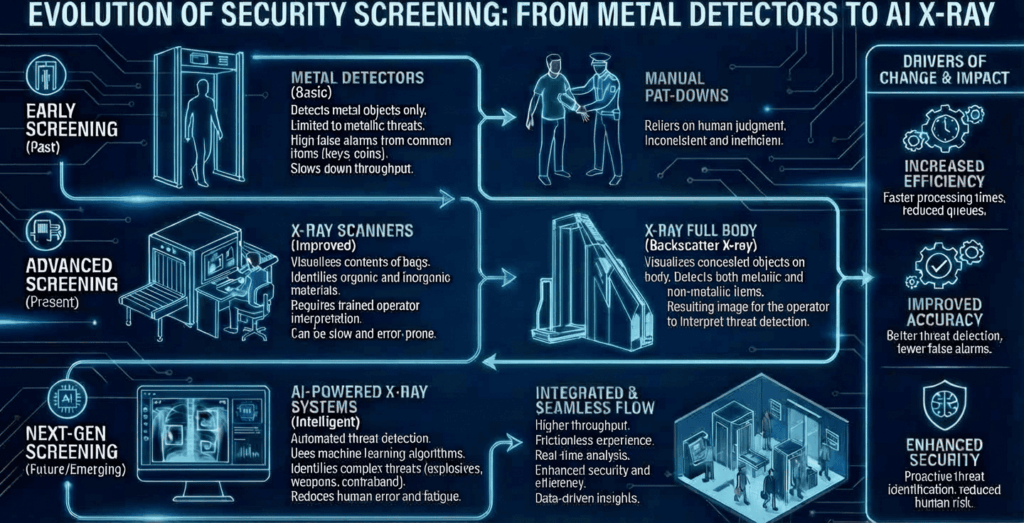
Traditional metal detectors and early-generation X-ray scanners were designed for environments with relatively predictable threats and lower throughput demands. While effective at identifying obvious metallic objects, these systems struggled to detect more sophisticated threats, such as non-metallic weapons, improvised explosives, and concealed contraband. The reliance on operators to quickly interpret 2D monochrome images often under high-pressure situations led to significant challenges, including variable interpretations among different operators, heightened fatigue and distraction risks in high-volume settings, and a reactive model that only identified known threats rather than anticipating new risks.
As the nature of threats evolved and became more complex, organizations found traditional screening technologies increasingly inadequate. This realization spurred the search for more advanced solutions capable of addressing modern security concerns.
The Emergence of Intelligent X-ray Security Systems
Over the years, X-ray technology has undergone significant advancements, with LINEV Systems® being a pioneer in the field of full-body X-ray scanning. Early innovations led to the development of AI-powered, multi-energy imaging systems, which represent the next frontier in security screening.
Multi-energy X-ray technology allows for the differentiation of materials based on how they interact with various energy levels. Unlike traditional systems, which identify objects based solely on their density, multi-energy X-rays enable a far more nuanced classification of materials—distinguishing metals, organics, and mixed materials while highlighting potential anomalies that would be difficult to detect using single-energy systems. When combined with AI algorithms trained on vast libraries of threat signatures, these systems transition from simple imaging tools to intelligent, threat-detecting machines.
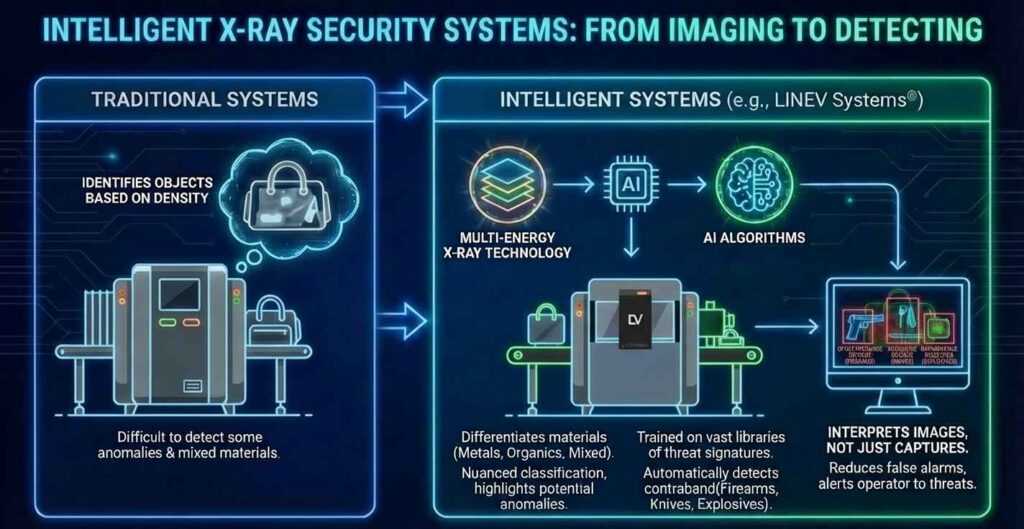
Our systems do more than capture images—they interpret them. Using advanced algorithms, they can automatically detect objects that resemble firearms, knives, explosives, or other contraband, drawing the operator’s attention to the relevant threat while reducing false alarms and unnecessary interruptions.
AI as a Force Multiplier for Security Teams
At LINEV Systems®, AI is not intended to replace human expertise but to augment it. Security personnel remain integral to decision-making, with AI serving as a force multiplier by streamlining and prioritizing their tasks. By embedding advanced threat-detection algorithms directly into the X-ray security systems, we reduce the cognitive load on operators, enabling them to focus on flagged suspicious items rather than scrutinizing every bag, parcel, or person individually.
This integration of AI enhances both security and operational efficiency, allowing security teams to process a higher volume of people and items without compromising threat detection or increasing false alarms. The result is a more effective and consistent screening process, which is particularly valuable in high-risk environments such as prisons, border crossings, mines, and large public events, where both throughput and risk levels are elevated.
Redesigning the Checkpoint Experience
The next-generation X-ray security systems do more than just enhance detection—they also transform the user experience at checkpoints. Traditional security procedures often felt confrontational, slow, and intrusive, with individuals waiting in long queues, removing personal items, and undergoing manual checks.
Modern X-ray security systems are designed with speed and flow in mind. Advanced systems enable quick, low-dose full-body scans that take only a fraction of a second to complete. Items can move continuously through screening tunnels while AI analyzes the contents in real time. The design of these systems is also more user-friendly, offering a less intimidating experience for the individuals being screened, which is especially important in high-traffic venues like stadiums and transportation hubs.
The ability to efficiently and non-intrusively screen large volumes of people without sacrificing security is a crucial consideration for modern public venues. Visitors expect not only to feel safe but also to experience minimal delays and discomfort. By adopting state-of-the-art X-ray systems, operators can achieve both strong security and a seamless, user-centric entry process.
Data Integration and the Future of Security
A key development in the evolution of security screening is the ability of modern systems to integrate seamlessly with broader security ecosystems. Unlike legacy systems, which operated as isolated devices, the X-ray systems at LINEV Systems® are designed to function within an interconnected network. These systems can integrate with video management platforms, access control systems, incident management tools, and analytics platforms, enabling comprehensive security management and real-time data sharing across an organization.
This integration supports a data-driven approach, where patterns can be analyzed over time and across different locations to detect emerging threats and recurring risks. AI models can be updated as new threat signatures are identified, allowing for continuous improvement in detection capabilities. Software updates and new features can be added without the need to replace existing hardware, ensuring that security infrastructure remains dynamic and adaptive to changing security challenges.
Low Dose, High Responsibility
With the deployment of any X-ray system, concerns about safety and privacy are paramount. At LINEV Systems®, we prioritize ultra-low-dose imaging and ensure that our systems comply with international radiation safety standards. We design our X-ray systems to deliver the lowest possible radiation dose while maintaining the image quality necessary for effective threat detection.
Moreover, we collaborate closely with our customers to ensure that operational policies, staff training, and communication strategies align with best practices. This includes providing clear, transparent explanations about how the technology works, how data is handled, and how images are stored and used. Security must balance the need for protection with respect for individuals’ privacy, dignity, and health.
The Future of Security Screening
As threats continue to evolve and public expectations for both safety and convenience increase, the gap between traditional screening technologies and the demands of modern security environments will only widen. The future of security is defined by the ability to adapt to new risks with smarter, faster, and more humane solutions.
At LINEV Systems®, we believe that the next decade of security will be defined by five core principles: Life, Innovation, Necessity, Evolution, and Vision. Our technologies are designed to protect lives, foster innovation to meet emerging challenges, and evolve from standalone devices to interconnected ecosystems. We maintain a clear vision for the future of security: one that is smarter, faster, more secure, and more compassionate.
The transition from traditional metal detectors to AI-enhanced X-ray security systems is well underway, and the key question is no longer whether this transition will take place, but how rapidly organizations can adapt and leverage the full potential of these modern systems.